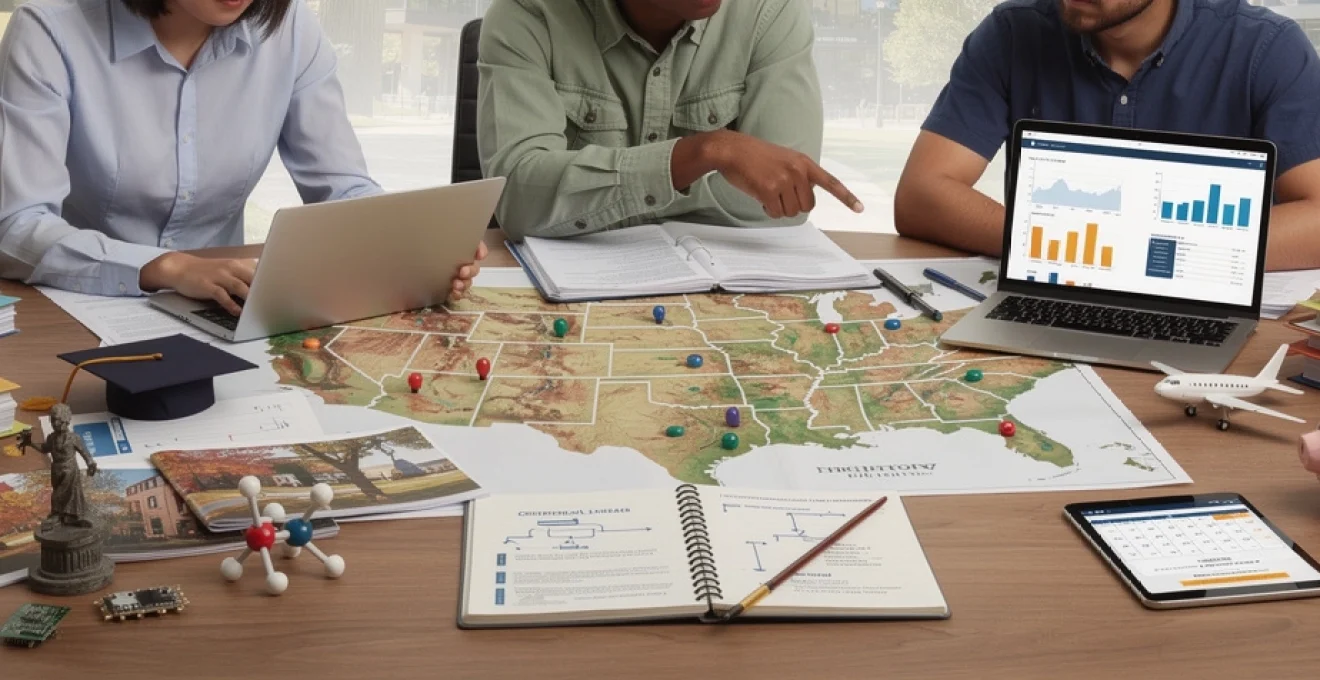
Pursuing higher education in the United States represents one of the most transformative academic experiences available to international students. With over 4,000 accredited institutions offering diverse programmes across every conceivable field of study, the American educational landscape provides unparalleled opportunities for intellectual growth and professional development. The country’s unique academic system combines rigorous scholarly pursuit with practical application, creating an environment where students can explore multiple disciplines whilst developing critical thinking skills essential for today’s global workforce.
The journey from initial course selection to successful graduation requires careful strategic planning, particularly for international students navigating complex visa requirements, financial considerations, and cultural adaptations. American universities welcome over one million international students annually, with institutions ranging from prestigious Ivy League research universities to innovative community colleges offering pathways to four-year degrees. Understanding the intricacies of this system before beginning your application process can significantly enhance your chances of admission and academic success.
Academic programme selection and university research for international students
Selecting the right academic programme in the United States begins with understanding the fundamental differences between American and international educational systems. Unlike many countries where students specialise early, American undergraduate education emphasises breadth of knowledge through general education requirements, allowing students to explore various subjects before declaring a major. This flexibility means you can enter university with an undeclared major and discover your passion through diverse coursework.
The research process for identifying suitable programmes should commence at least 18 months before your intended start date. Begin by utilising comprehensive databases and ranking systems to evaluate institutions based on your academic interests, career goals, and personal preferences. Consider factors such as faculty-to-student ratios, research opportunities, internship programmes, and alumni networks when evaluating potential universities.
Undergraduate vs postgraduate programme requirements and admission criteria
Undergraduate admissions in the United States typically require completion of secondary education equivalent to an American high school diploma. International students must demonstrate English proficiency through standardised tests such as TOEFL or IELTS, with most universities requiring minimum scores between 80-100 for TOEFL or 6.5-7.5 for IELTS. Academic transcripts require evaluation through credential evaluation services to ensure compatibility with American grading systems.
Graduate programme admissions involve more specialised requirements, including bachelor’s degree completion, letters of recommendation, statement of purpose, and often standardised test scores such as GRE, GMAT, or subject-specific examinations. Research-intensive programmes frequently require demonstrated research experience or published academic work, whilst professional programmes may emphasise work experience and career objectives.
STEM fields vs liberal arts programme structures at Top-Tier universities
STEM programmes in American universities typically follow structured curricula with prerequisite courses building foundational knowledge before advanced specialisation. Engineering programmes often require mathematics, physics, and chemistry prerequisites, whilst computer science programmes emphasise programming languages and algorithmic thinking from the first year. These programmes frequently incorporate hands-on laboratory work and industry partnerships.
Liberal arts programmes offer greater flexibility, encouraging interdisciplinary study and critical thinking development. Students can combine majors and minors across departments, creating unique academic profiles that reflect their interests and career aspirations. Many liberal arts colleges pride themselves on small class sizes and close faculty mentorship, fostering intellectual discourse and personalised attention that larger research universities may not provide.
Community college transfer pathways to Four-Year institutions
Community colleges represent an increasingly popular pathway for international students seeking cost-effective entry into American higher education. These two-year institutions offer associate degrees and transfer programmes designed to seamlessly integrate with four-year university curricula. Students can complete general education requirements at significantly reduced costs before transferring to complete their bachelor’s degree.
Transfer agreements between community colleges and universities guarantee admission for students meeting specific academic criteria. California’s transfer system, for example, provides guaranteed admission to University of California campuses for students completing transfer requirements with minimum GPA thresholds. This pathway can reduce total education costs by 40-50% whilst maintaining access to prestigious universities.
Research university rankings: US news, QS world rankings, and carnegie classifications
University rankings provide valuable insights into institutional quality and reputation, though they should be considered alongside personal fit factors. US News & World Report rankings emphasise academic excellence, faculty resources, and
student outcomes, while QS World Rankings place stronger emphasis on international outlook and research impact. Understanding these methodologies helps you interpret why a university might rank differently across platforms and prevents you from relying on a single number. The Carnegie Classification system, meanwhile, categorises institutions based on research activity and degree offerings, distinguishing between research-intensive universities, master’s institutions, and community colleges. When planning a course in the USA to continue your studies, use rankings as a starting point, then dive deeper into department-level reputation, faculty publications, and specific programme strengths relevant to your field.
Geographic considerations: east coast ivy league vs west coast tech hubs vs midwest research universities
Geography plays a crucial role in your academic and personal experience in the United States. East Coast institutions, including Ivy League universities and other elite schools, often offer historic campuses, dense academic networks, and proximity to major financial, political, and cultural centres such as New York, Boston, and Washington, D.C. If you are drawn to fields like finance, international relations, law, or publishing, studying in this region can provide unparalleled internship and networking opportunities.
West Coast universities, by contrast, are closely tied to the technology and innovation ecosystems of Silicon Valley, Seattle, and San Diego. Institutions in California and the Pacific Northwest typically emphasise entrepreneurship, engineering, computer science, and life sciences, often collaborating directly with major tech companies and start-ups. For students in STEM fields who want to combine research with industry exposure, this environment can be especially attractive.
The Midwest and Southern regions host many large public research universities and affordable institutions with strong engineering, agriculture, business, and health sciences programmes. These campuses often feature lower costs of living, tight-knit communities, and substantial on-campus resources. When you plan where to study in the USA, consider climate preferences, cultural environment, industry presence, and distance from family, as these factors will significantly influence your overall satisfaction and academic performance.
F-1 student visa application process and SEVIS documentation requirements
Once you have shortlisted your preferred institutions and programmes, the next critical step is securing the appropriate immigration status to study in the USA. Most international students enrol on an F-1 visa, which is designed for full-time academic study at an SEVP-certified school. The F-1 visa process involves multiple stages, including obtaining your Form I-20, registering in the Student and Exchange Visitor Information System (SEVIS), and completing a consular interview. Navigating these requirements systematically will help you avoid delays or visa denials that could derail your study plans.
Form I-20 acquisition and student exchange visitor information system registration
The Form I-20, officially titled Certificate of Eligibility for Nonimmigrant Student Status, is the cornerstone of your F-1 visa application. After you receive an offer of admission and provide proof of sufficient funding, your university’s Designated School Official (DSO) will generate and send your I-20. This document specifies your programme start and end dates, field of study, and estimated annual costs, and you must check every detail carefully for accuracy before proceeding.
Once you have your I-20, you are required to pay the SEVIS I-901 fee, which supports the Student and Exchange Visitor Program’s oversight of international students. Payment generates a SEVIS record tied to your unique SEVIS ID number printed on the I-20. Keep your payment confirmation in a safe place, as you will need it both for your DS-160 visa application and during your consular interview. Treat SEVIS as your digital academic identity in the USA: it follows you if you transfer schools, change programmes, or apply for Optional Practical Training.
DS-160 online application and consular interview preparation at US embassies
With your I-20 and SEVIS fee receipt in hand, you can complete the online DS-160 nonimmigrant visa application. This form collects detailed biographical information, travel history, and security-related questions, and must be completed truthfully and carefully. After submitting the DS-160, you will receive a confirmation page with a barcode, which you must print and bring to your visa interview at the US embassy or consulate in your country.
Preparing for the consular interview is much like preparing for an important oral exam. You should be ready to explain why you chose your specific course and university, how the programme fits into your long-term career plans, and how you will finance your studies and living expenses. Visa officers primarily assess whether you are a genuine student and whether you intend to respect the terms of your student status. Answer questions clearly and confidently, bring all required documents neatly organised, and ensure that the information on your DS-160, I-20, and financial statements is consistent.
Financial documentation: I-94 records and proof of funding requirements
Proof of funding is one of the most important components of your F-1 visa application. Universities typically require bank statements, scholarship letters, or sponsor affidavits demonstrating that you can cover at least one academic year of tuition, fees, and living expenses. Consular officers may request to see these documents to verify that your financial plan is realistic and sustainable. If you are relying on multiple funding sources, such as family contributions, scholarships, and personal savings, make sure each source is clearly documented.
The I-94 record, by contrast, is created when you enter the United States and indicates your immigration status and authorised period of stay. For F-1 students, the I-94 usually lists “D/S” (Duration of Status) rather than a specific exit date, meaning you may remain in the country as long as you maintain your student status. After arrival, you can retrieve your I-94 online and should keep a copy with your immigration documents. Together, your financial documentation and I-94 history will be essential if you later apply for work authorisation, a programme extension, or a change of status.
Sevp-certified institution verification and maintaining legal student status
Not every educational provider in the USA is authorised to enrol international students, so it is vital to verify that your chosen institution is SEVP-certified. Enrolling at a non-certified school could jeopardise your ability to obtain or maintain your F-1 visa. SEVP-certified institutions have DSOs trained to advise you on immigration regulations, course load requirements, and authorised employment such as on-campus work or Optional Practical Training (OPT). Before accepting any offer, confirm the school’s certification status through official government resources or the institution’s international office.
Maintaining legal student status requires more than simply holding a valid visa; you must actively comply with federal regulations throughout your studies. This includes enrolling full-time each term, attending classes regularly, and seeking DSO approval before dropping courses, changing programmes, or taking a leave of absence. You must also report address changes, travel plans, and any authorised employment to your DSO so that your SEVIS record remains current. Think of maintaining status as following a detailed syllabus: if you stay organised and communicate with your DSO whenever you face difficulties, you significantly reduce the risk of status violations that could affect your future in the USA.
Financial planning strategies and funding sources for US higher education
Because tuition and living costs can be high, careful financial planning is essential when you design your course of study in the USA. By understanding tuition structures, scholarship opportunities, and cost-of-living differences between cities, you can build a realistic budget and avoid unpleasant surprises. Many international students successfully finance their education through a combination of personal funds, family support, institutional aid, and part-time on-campus work. Treat financial planning as part of your academic strategy: the more proactive you are now, the more freedom you will have to focus on studies later.
Tuition fee structures: in-state vs out-of-state vs international student rates
US universities use tiered tuition structures that vary significantly depending on your residency status and institution type. Public universities usually charge lower “in-state” tuition for residents of their own state, higher “out-of-state” rates for domestic students from other states, and often the highest rates for international students. Private universities typically charge a single tuition rate for all students, which may initially appear more expensive but can be offset by generous need-based or merit-based aid packages.
To plan your course in the USA effectively, you should compare not just headline tuition numbers but the total cost of attendance, including fees, health insurance, books, and housing. Some states and institutions participate in regional reciprocity agreements or offer special tuition categories that can reduce costs for certain international students, particularly at the graduate level. When evaluating offers, ask yourself: how does the net cost after scholarships compare across universities, and does the academic quality justify the investment?
Merit-based scholarships: fulbright program, rhodes scholarship, and university-specific awards
Merit-based scholarships can substantially reduce the financial burden of studying in the United States, especially for high-achieving international students. Prestigious programmes like the Fulbright Foreign Student Program provide funding for graduate study, research, and professional development in a wide range of disciplines, often covering tuition, living expenses, and travel. The Rhodes Scholarship, while focused on graduate study at the University of Oxford, is sometimes considered alongside US options by students planning an international academic trajectory and can complement a broader strategy for global education.
Most US universities also offer their own merit-based awards based on academic performance, leadership, artistic talent, or athletic ability. These university-specific scholarships can range from partial tuition discounts to full-ride packages that include room and board. To maximise your chances, submit applications early, maintain a strong academic record, and highlight your unique achievements in your personal statement and recommendation letters. Remember, you are often competing with applicants worldwide, so clear evidence of academic excellence, community engagement, or research potential can set you apart.
Graduate assistantships: teaching assistant and research assistant funding models
For postgraduate students, graduate assistantships are one of the most effective ways to fund a degree in the USA. Teaching Assistant (TA) positions typically involve leading discussion sections, grading assignments, or supporting undergraduate instruction, while Research Assistant (RA) roles focus on contributing to faculty research projects. In exchange for 10–20 hours of work per week, assistantships often provide a tuition waiver, health insurance, and a monthly stipend sufficient to cover basic living expenses.
Assistantships are particularly common in STEM fields and research-intensive departments, but they also exist in social sciences and humanities. Competition for these roles can be strong, so you should express your interest early—both in your application materials and through direct communication with potential supervisors. Think of an assistantship as a dual investment: you are funding your education while gaining practical teaching or research experience that will strengthen your CV and improve your employment prospects after graduation.
Cost of living analysis: campus housing vs off-campus accommodation in major university cities
While tuition often receives the most attention, the cost of living can vary dramatically between US cities and has a major impact on your overall budget. Living in university-managed housing can be more expensive per month than some off-campus options, but it often includes utilities, internet, and meal plans, making it easier to manage expenses and adapt to life in a new country. On-campus accommodation also places you close to classes, libraries, and extracurricular activities, which can be invaluable during your first year.
Off-campus housing, especially in major urban centres like New York, Boston, or San Francisco, can be both more flexible and more complex. Rents may be higher, leases longer, and additional costs such as transportation and furnishings can add up quickly. Before deciding, compare sample monthly budgets for each city you are considering, including rent, groceries, transport, and health insurance. Asking current international students about their real-world expenses can help you avoid underestimating costs and ensure that your financial plan aligns with your lifestyle expectations.
Academic credit transfer and transcript evaluation procedures
If you are continuing your studies in the USA after completing coursework or a degree elsewhere, understanding credit transfer and transcript evaluation is crucial. US institutions need to determine how your previous studies compare to their own curriculum, which affects your placement, time to graduation, and overall tuition costs. Independent credential evaluation agencies, such as WES (World Education Services) or similar bodies, analyse your transcripts, convert grades to the US GPA scale, and assess the level and content of your courses.
Universities then review these evaluations to decide which credits to accept and how they apply to your chosen programme—some may count toward core requirements, while others might be classified as electives. Policies vary widely: a course that transfers as full credit at one university may only count partially at another. To avoid surprises, request official syllabi from your previous institutions, keep detailed records of coursework and contact hours, and consult your prospective university’s international admissions or academic advising office early. By approaching credit transfer like a puzzle—matching each previous course to a US equivalent—you can often shorten your degree path and save both time and money.
Timeline management and application deadlines for US academic institutions
Effective timeline management is one of the most underestimated aspects of planning a course in the USA. Many universities open applications 10–12 months before the academic year begins, and competitive programmes may have priority deadlines even earlier. As a rule of thumb, you should begin researching institutions and preparing for standardised tests such as TOEFL, IELTS, GRE, or SAT at least 18 months before your intended start date. This lead time allows you to retake exams if necessary and compile strong application materials.
Most undergraduate programmes set application deadlines between November and January for the following autumn intake, while graduate programmes may have multiple rounds spanning from December to March. Visa processing, scholarship applications, and housing reservations all have their own timetables, which can overlap and become complex. To stay organised, create a master calendar listing test dates, application deadlines, recommendation request dates, and visa milestones. Treat these deadlines like a series of project deliverables: by breaking the process into manageable tasks, you reduce stress and increase the quality of each component of your application.
Post-graduation employment opportunities and optional practical training regulations
When you plan your studies in the USA, it is wise to think beyond graduation and consider how your degree can translate into work experience. The F-1 visa allows eligible students to apply for Optional Practical Training (OPT), a form of temporary employment directly related to their major field of study. Standard OPT provides up to 12 months of full-time work authorisation, which can be used either during your studies (pre-completion OPT) or after you finish your programme (post-completion OPT). Many students choose post-completion OPT to gain hands-on experience in the US job market.
Students in designated STEM fields may qualify for a 24-month STEM OPT extension, allowing up to 36 months of total OPT. To be eligible, you must graduate from a SEVP-certified institution, work for an employer enrolled in E-Verify, and comply with specific reporting requirements through your DSO. Think of OPT as a bridge between your academic training and longer-term professional goals: it enables you to apply classroom knowledge in real-world settings, build a professional network, and potentially transition to another status such as H-1B if opportunities arise. By understanding OPT regulations early, you can choose programmes and majors that align with your career ambitions and maximise your post-study options in the United States.