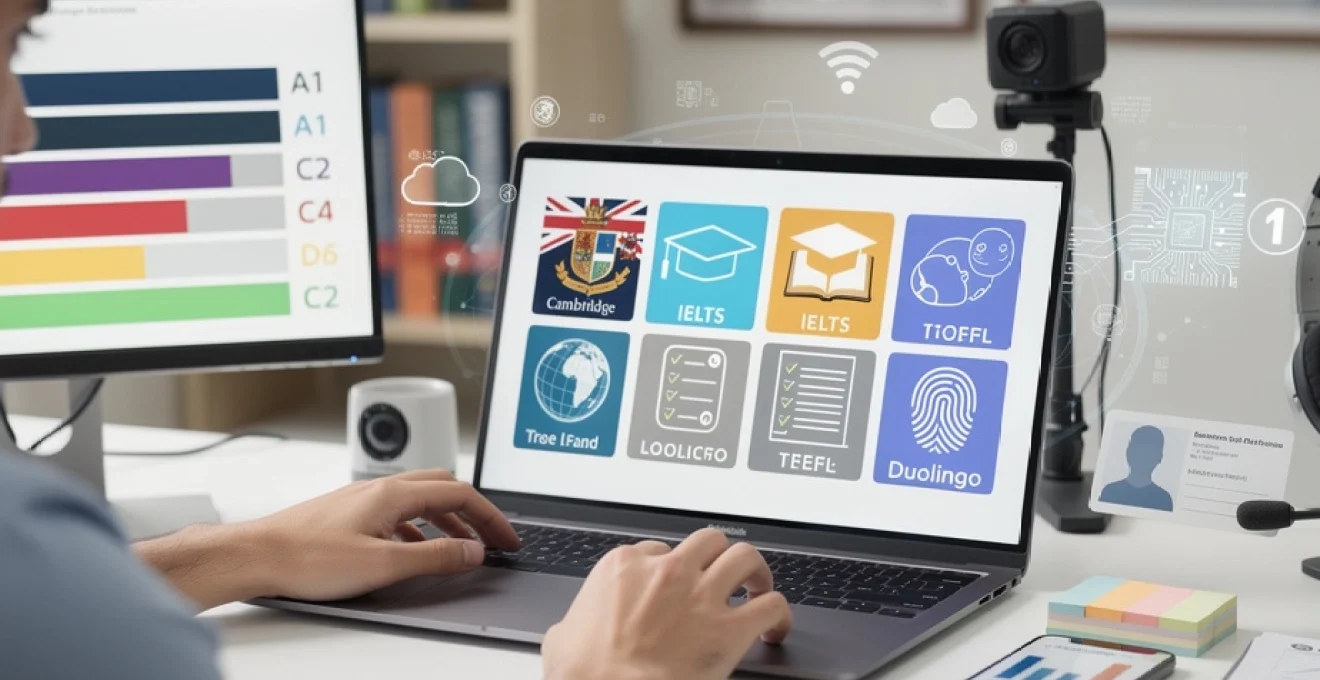
The digital transformation of language assessment has revolutionised how individuals demonstrate their linguistic competency for academic, professional, and immigration purposes. With over 1.5 billion English language learners worldwide and increasing demand for flexible testing solutions, online language examinations have become the preferred choice for millions of test-takers annually. The proliferation of computer-delivered assessments, adaptive testing technologies, and remote proctoring systems has created a complex landscape of certification options that require careful navigation.
Modern language proficiency testing encompasses a sophisticated ecosystem of internationally recognised qualifications, each designed to meet specific requirements and contexts. From university admissions to professional licensing, visa applications to career advancement, the stakes of choosing the appropriate examination have never been higher. Understanding the nuances of different testing platforms, their technological requirements, and alignment with your objectives becomes crucial for achieving optimal outcomes in today’s competitive global environment.
Understanding language proficiency assessment standards and certification bodies
Common european framework of reference (CEFR) level classifications
The Common European Framework of Reference for Languages serves as the foundation for virtually all modern language assessment systems. This internationally recognised standard divides language proficiency into six distinct levels, from A1 (basic user) through C2 (proficient user), providing a consistent benchmark across different testing organisations and geographical regions. The CEFR framework evaluates competency across four key skills: reading, writing, listening, and speaking, whilst also incorporating mediation skills that reflect real-world language use in professional and academic contexts.
Level A1 represents breakthrough competency, where learners can understand and use familiar everyday expressions and basic phrases. A2 indicates waystage proficiency, enabling communication in routine tasks requiring simple exchanges of information. B1 threshold users can deal with most situations encountered in regions where the language is spoken, whilst B2 vantage users demonstrate independence in complex text comprehension and spontaneous interaction with native speakers. C1 effective operational proficiency encompasses understanding of demanding texts and flexible language use, while C2 mastery approaches native-speaker competency with nuanced expression and cultural understanding.
International testing organisations: cambridge assessment, ETS, and british council
Cambridge Assessment English, Educational Testing Service (ETS), and the British Council represent the triumvirate of global language testing authorities, each bringing distinct methodological approaches and technological innovations to online assessment. Cambridge Assessment English, with over a century of experience, emphasises academic rigour and practical application through examinations that reflect authentic communication scenarios. Their computer-based testing infrastructure supports over 2,800 authorised centres worldwide, processing more than 5.5 million test-takers annually across various qualification levels.
ETS pioneered computer-adaptive testing through the TOEFL iBT platform, utilising sophisticated algorithms that adjust question difficulty based on test-taker performance in real-time. This American-based organisation processes over 700,000 TOEFL examinations yearly, with their Home Edition format accounting for approximately 40% of all administrations since its introduction. The British Council, jointly owning IELTS with Cambridge Assessment, manages the world’s most popular English proficiency test, with over 4 million candidates annually choosing IELTS for academic, professional, and immigration purposes.
Academic vs professional certification requirements
Academic institutions typically require comprehensive assessment of all four language skills, with particular emphasis on academic writing conventions and complex reading comprehension abilities. Universities often specify minimum band scores or grade thresholds for different programmes, with postgraduate courses generally demanding higher proficiency levels than undergraduate admission. Medical, engineering, and business programmes frequently establish additional speaking requirements to ensure students can participate effectively in seminars, presentations, and clinical interactions.
Professional certification contexts emphasise practical communication competencies relevant to specific industry sectors. Legal professions prioritise precise written expression and formal register usage, whilst healthcare certifications focus heavily on listening comprehension and clear spoken communication for patient interaction. Business English assessments evaluate negotiation skills, presentation abilities, and cross-cultural communication competency that directly impacts workplace effectiveness and career progression opportunities.
Digital proctoring technologies and remote assessment protocols
Advanced proctoring technologies have transformed the integrity and accessibility of online language examinations through multi-layered security measures and real-time monitoring capabilities. Artificial intelligence systems analyse behavioural patterns, detecting anomalous activities such as unusual eye movements
and body posture that may indicate potential misconduct, while human invigilators supervise multiple candidates simultaneously via secure video feeds. Identity verification combines government-issued ID checks, facial recognition, and sometimes keystroke biometrics to confirm that the registered candidate is the person taking the test. Remote assessment protocols typically require a 360-degree room scan, restricted access to personal belongings, and lockdown browsers that prevent switching between applications during the exam.
For you as a test-taker, this means that preparing for an online language exam is not only about your English skills, but also about understanding the rules of remote proctoring. Any breach of protocol, even unintentional, can lead to invalidated results or bans from retesting. Before exam day, review the proctoring guidelines, test your webcam and microphone, and practise sitting through a full-length mock test in similar conditions. This will help you stay focused on your language performance rather than worrying about the technology monitoring you in the background.
Comprehensive analysis of major online language examination platforms
Cambridge english qualifications: B2 first, C1 advanced, and C2 proficiency
Cambridge English Qualifications such as B2 First, C1 Advanced, and C2 Proficiency are long-established, high-stakes exams that now offer computer-based formats in many locations. While not fully “at home” exams, their digital delivery mirrors online language exams in timing, navigation, and on-screen tools, making them a strong option if you prefer a test centre environment with modern technology. Each qualification targets a specific CEFR band: B2 First focuses on upper-intermediate users, C1 Advanced on advanced academic and professional users, and C2 Proficiency on near-native mastery.
In terms of structure, all three Cambridge English exams assess reading, use of English (grammar and vocabulary in context), writing, listening, and speaking. The speaking component is always conducted face-to-face (or via live video link), which many candidates find more natural than speaking into a microphone. A key advantage of these qualifications is their long-term recognition: unlike some online English tests that expire after two years, Cambridge certificates are technically valid for life, and widely accepted by universities and employers across the UK, Europe, and beyond. If your goal is to prove sustained proficiency for both study and work, these fixed-level exams provide a robust, internationally trusted benchmark.
IELTS Computer-Delivered tests and IELTS indicator assessment
IELTS has expanded far beyond the traditional paper-based format to include computer-delivered tests and, in some regions, remote options like IELTS Indicator. IELTS Academic and General Training are both available as computer-based exams at authorised centres, offering faster results (typically within 3–5 days) and flexible scheduling. The content and scoring scale remain identical to the paper version, so choosing computer-delivered IELTS is mainly about convenience and your personal comfort with typing and on-screen reading.
IELTS Indicator, introduced during the COVID-19 pandemic, was designed as an online language exam that candidates could take from home. It followed the same band score system (0–9) and assessed the four skills, but its availability and acceptance have varied over time and across institutions. When considering IELTS as your online English proficiency test, always check whether your target university or immigration authority accepts computer-delivered results, remote formats, or only centre-based tests. For many candidates, the combination of global recognition, flexible delivery, and options like One Skill Retake makes IELTS one of the most strategic choices for online language assessment.
TOEFL iBT home edition and institutional testing programme
The TOEFL iBT remains a flagship exam for academic English, especially in North America, with the Home Edition providing a fully online alternative to test-centre delivery. The TOEFL iBT Home Edition uses the same format, scoring scale (0–120), and test content as the centre-based test, but adds strict remote proctoring to ensure integrity. You complete all tasks on your computer, including speaking into a microphone rather than interacting with a live examiner, which some candidates find less intimidating.
Alongside the standard iBT, ETS offers institutional testing solutions that allow universities or employers to run secure sessions for groups of candidates, often using remote proctoring and local invigilation. These programmes can be particularly useful for pathway colleges, corporate training schemes, or scholarship bodies that need a scalable online English test. If your primary objective is admission to a US or Canadian institution and you prefer a single, globally recognised academic English exam, the TOEFL iBT—whether at home or in a centre—remains a safe and strategic choice.
Duolingo english test adaptive assessment methodology
The Duolingo English Test (DET) is a fully online, on-demand exam that uses computer-adaptive testing to measure your proficiency quickly and efficiently. Instead of fixed sections, the DET adjusts the difficulty of each item in real time based on your previous answers, allowing it to estimate your level in around 45–60 minutes. Its scoring scale (10–160) is mapped to CEFR levels, and many universities now publish Duolingo score requirements alongside IELTS and TOEFL, particularly for undergraduate admissions.
From a user perspective, the Duolingo English Test feels more like an interactive app than a traditional exam, with integrated tasks that combine reading, listening, speaking, and writing. Because it is available 24/7 and results arrive in 2–5 days, it is one of the most flexible online English exams for tight application deadlines. However, not all institutions accept it for visa or postgraduate purposes, so you should always confirm recognition before relying on it. If you need a fast, accessible test that you can take from home and that uses modern adaptive assessment technology, Duolingo’s model is worth serious consideration.
Pearson PTE academic online and versant professional english tests
Pearson’s PTE Academic and its online variant have gained significant ground as fully computer-based English proficiency exams, particularly for study in Australia, New Zealand, and parts of Europe and Asia. PTE Academic Online mirrors the centre-based test in format and scoring, but uses remote proctoring so that you can complete the exam from home. The test is entirely machine-scored, combining automated speech recognition and advanced analytics to evaluate your responses across speaking, writing, reading, and listening skills.
Beyond academic admissions, Pearson’s Versant tests target workplace needs through short, on-demand assessments of spoken and written English. Versant exams are often used by employers to benchmark language skills for recruitment, promotion, or training evaluation, making them a practical option if your primary focus is professional English. If you are deciding between different online English tests for immigration, university, and work, PTE Academic offers strong recognition and fast turnaround times, while Versant provides targeted, low-stakes tools to evidence your communication skills in specific roles or industries.
Technical infrastructure requirements for online language assessment
Computer-based testing (CBT) system specifications and compatibility
Before booking any online language exam, it is essential to confirm that your hardware and software meet the minimum system requirements. Most providers specify a recent operating system (for example, Windows 10 or macOS 12), a dual-core processor, at least 4–8 GB of RAM, and a screen resolution that supports their secure browser. Many online English tests only support specific browsers—often Google Chrome—so using an unsupported browser can lead to technical failures or incomplete submissions.
Compatibility checks usually include a pre-test systems scan that evaluates your webcam, microphone, speakers, and internet connection. Running this check well before your exam date helps you identify issues with drivers, security settings, or corporate firewalls that could interrupt the test. Think of this as rehearsing a performance with your equipment: the more you simulate real exam conditions, the less likely you are to face surprises when your score is on the line. Whenever possible, use a personal computer rather than a work device, as institutional security policies can block key proctoring functions.
Artificial intelligence scoring algorithms and natural language processing
Many modern online English exams rely on artificial intelligence scoring algorithms to evaluate speaking and writing performance at scale. These systems use natural language processing to analyse pronunciation, fluency, grammatical accuracy, vocabulary range, and coherence in your responses. Just as a music app can recognise different genres and instruments, AI scoring models learn from large datasets of human-marked scripts to predict scores that align with expert judgements.
For you, this means that consistency and clarity become especially important: AI engines are trained to detect patterns, so frequent hesitation, mumbling, or incomplete sentences may lower your score even if your ideas are strong. On the positive side, automated scoring allows for rapid, reliable results and reduces human bias, particularly in high-volume online language exams. To perform well in AI-scored environments, practise recording yourself, reviewing transcripts, and focusing on clear sentence boundaries and logical structure rather than memorised answers that sound unnatural.
Biometric authentication systems and identity verification protocols
Biometric authentication has become a cornerstone of secure online assessment, helping test providers confirm candidate identity and prevent impersonation. Common methods include facial recognition that compares your live image to your ID document, voice samples for spoken tasks, and even keystroke dynamics that recognise your unique typing rhythm. These technologies create a multi-factor security net, much like multiple locks on a door, making it harder for fraudulent activity to go undetected.
During registration and on test day, you will typically be asked to provide a high-resolution photo of your ID, capture your face from different angles, and sometimes read text aloud for voice matching. It is crucial that your testing environment is well lit and that your camera is positioned clearly, as poor lighting or blurry images can trigger verification failures. Familiarise yourself with these protocols in advance by reading the provider’s guidelines and completing sample checks; that way, biometric verification becomes a smooth formality rather than a stressful obstacle.
Network bandwidth requirements and technical support infrastructure
Stable, high-speed internet connectivity is non-negotiable for online language exams, especially those with live proctoring and real-time audio or video streaming. Many providers recommend a minimum download speed of 2–3 Mbps and upload speed of 1–2 Mbps, though higher bandwidths offer greater reliability during peak usage times. If your connection frequently drops or slows, consider using a wired Ethernet connection instead of Wi‑Fi, or schedule your test for a time when household internet traffic is minimal.
Equally important is the availability of responsive technical support before and during your exam. Leading providers offer live chat or phone support, detailed FAQs, and troubleshooting guides to help you resolve issues quickly. Ask yourself: if my audio suddenly stops working, do I know exactly who to contact and how? Taking a few minutes to note emergency contact methods and support hours can make the difference between a cancelled test and a successful session when problems arise.
Strategic selection criteria based on academic and professional objectives
Choosing the right online language exam begins with a clear understanding of your end goal: are you targeting university admission, professional licensing, internal promotion, or immigration? Different stakeholders have specific preferences, and some may only accept certain certificates. For example, a UK university might accept IELTS, TOEFL, PTE, and C1 Advanced, while a particular visa route may list only IELTS and PTE for migration purposes. Always start by checking the official requirements page of your target institution or authority before selecting a test.
Beyond recognition, consider how well each exam format matches your skill profile and test-taking style. If you excel at academic essays and complex reading, a test like C1 Advanced or TOEFL iBT may highlight your strengths. If you prefer integrated, shorter tasks and a more app-like experience, the Duolingo English Test or PTE Academic could be more comfortable. You should also weigh long-term value: do you need a certificate that remains relevant for future job applications, or simply a fast result for an upcoming application deadline? Balancing recognition, format, and longevity will help you choose an online language exam that aligns with both your immediate and long-term objectives.
Cost-benefit analysis and examination scheduling considerations
The cost of online English proficiency tests varies significantly, typically ranging from around USD 60–80 for Duolingo to USD 200–300 for major exams like IELTS, TOEFL, and PTE Academic. At first glance, it may be tempting to choose the cheapest option, but a more strategic approach is to compare total value: acceptance range, certificate validity, rescheduling policies, and the possibility of retaking only one skill. An exam that is slightly more expensive but recognised by more universities and visa authorities may save you both time and money in the long run.
Scheduling is another crucial factor in your cost-benefit analysis. Some tests offer almost on-demand appointments, while others have fixed dates that may not align with application deadlines. Consider how quickly results are released and whether you can send score reports to multiple institutions at no extra cost. It can be helpful to create a simple timeline with application deadlines, ideal test dates, and buffer periods for retakes. By planning backward from your goal, you reduce the risk of paying extra fees for urgent bookings or express score reporting because of last-minute decisions.
Preparation strategies for computer-adaptive testing environments
Preparing for computer-adaptive online language exams requires slightly different strategies from traditional fixed-form tests. Because question difficulty changes in response to your performance, your goal is not to achieve perfection on every item, but to demonstrate a consistent, stable level across the test. Think of it as a thermostat that adjusts the temperature of the questions: if you perform well, the test challenges you more; if you struggle, it offers easier tasks to identify your true level.
To adapt effectively, focus on building broad, balanced skills rather than memorising answers to specific question types. Practise with official sample tests or adaptive practice platforms so that you become comfortable with fluctuating difficulty and varied item formats. During the exam, avoid panicking if questions suddenly feel harder—that is often a sign that you are performing well. Instead, manage your time carefully, read instructions calmly, and treat each task as a fresh opportunity to show accurate, clear, and communicative language.